UAE Corporate Tax Relief Extended to 2029: Complete Guide
The UAE's Corporate Tax relief for small businesses reported extension to 2029, giving eligible UAE businesses additional time to benefit from the Small Business Relief (SBR) regime.
Under the reported extension, eligible UAE Resident Persons with revenue of AED 3 million or less can continue to elect for Small Business Relief, subject to the applicable conditions and exclusions. The relief was previously scheduled to apply to Tax Periods ending on or before 31 December 2026.
For startups, entrepreneurs, SMEs, and growing businesses across Dubai, Abu Dhabi, and the other Emirates, the extension provides additional tax-planning opportunities. However, Small Business Relief is not an automatic Corporate Tax exemption, and businesses still need to understand registration, filing, accounting, eligibility, and record-keeping requirements.
This guide explains what the UAE Corporate Tax Relief 2029 development means for small businesses, who may qualify, the AED 3 million revenue threshold, important exclusions, and what businesses should do next.
Important: Corporate Tax rules and administrative guidance can change. Businesses should verify the latest Federal Tax Authority and Ministry of Finance guidance before making a Small Business Relief election.
Key Takeaways
UAE Small Business Relief has been reported as extended through 2029, giving eligible small businesses additional relief under the UAE Corporate Tax framework.
The key revenue threshold remains AED 3 million under the reported extension.
Eligible businesses must elect for Small Business Relief rather than assuming it applies automatically.
SBR can allow an eligible taxpayer to be treated as having no Taxable Income for the relevant Tax Period, subject to the applicable conditions.
Qualifying Free Zone Persons (QFZPs) cannot elect for Small Business Relief.
Certain members of Multinational Enterprise (MNE) Groups are also excluded.
Businesses should continue maintaining proper accounting records and supporting documentation.
SBR should be evaluated alongside Tax Losses, Net Interest Expenditure, business growth, and future Corporate Tax planning.
Corporate Tax relief does not necessarily mean Corporate Tax registration is unnecessary.
What Is UAE Corporate Tax Relief 2029?
The phrase “UAE Corporate Tax Relief 2029” generally refers to the reported extension of the UAE's Small Business Relief (SBR) regime to Tax Periods ending on or before 31 December 2029.
Small Business Relief was introduced under Article 21 of Federal Decree-Law No. 47 of 2022 on the Taxation of Corporations and Businesses to support eligible small businesses and startups.
Under SBR, an eligible Resident Person can elect to be treated as having no Taxable Income for the relevant Tax Period, provided the applicable conditions are satisfied.
The original Small Business Relief framework was introduced through Ministerial Decision No. 73 of 2023 and was initially scheduled to cover Tax Periods ending on or before 31 December 2026.
The newly reported extension would provide eligible businesses with additional relief through 2029.

What Changed With the UAE Corporate Tax Relief Extension?
The most important reported change is the extension of the Small Business Relief period.
Previous position
Small Business Relief was scheduled to apply to Tax Periods ending on or before:
31 December 2026
Reported new position
The relief has been reported as extended to Tax Periods ending on or before:
31 December 2029
What remains important?
The core eligibility concept remains centered around the AED 3 million revenue threshold and the other conditions that apply to SBR.
This means eligible small businesses may have additional time to benefit from the regime rather than losing access after 2026.
Who Can Benefit From UAE Small Business Relief in 2029?
Small Business Relief is designed for eligible Resident Persons whose revenue falls within the prescribed threshold and who satisfy the other conditions under the UAE Corporate Tax rules.
A business should assess:
Whether it is a Resident Person for UAE Corporate Tax purposes.
Whether its revenue is within the AED 3 million threshold.
Whether previous relevant Tax Periods also satisfy the revenue requirement.
Whether the business falls within an excluded category.
Whether making the SBR election is appropriate for its circumstances.
Whether all required accounting records and supporting documents are maintained.
This means that simply having revenue below AED 3 million does not automatically guarantee eligibility.
What Is the AED 3 Million Small Business Relief Threshold?
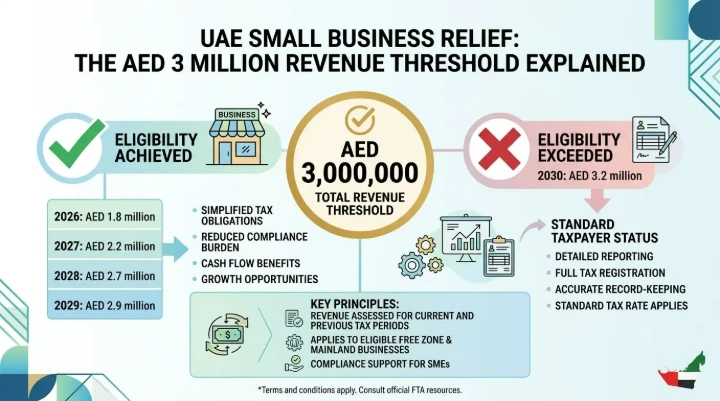
The AED 3 million revenue threshold is one of the most important parts of the UAE Small Business Relief regime.
Under the SBR framework, eligible businesses need to assess revenue for the relevant Tax Period as well as applicable previous Tax Periods.
For example:
| Tax Period | Revenue |
|---|---|
| 2026 | AED 1.8 million |
| 2027 | AED 2.2 million |
| 2028 | AED 2.7 million |
| 2029 | AED 2.9 million |
A business that remains below the applicable threshold may potentially continue to qualify, assuming all other requirements are satisfied.
However, businesses approaching AED 3 million should monitor revenue carefully because crossing the threshold can affect eligibility.
Important distinction: Revenue vs Profit
The AED 3 million SBR test is based on revenue, not simply taxable profit.
This is an important distinction for business owners.
A company could have relatively low profit but still exceed the AED 3 million revenue threshold and therefore need to consider whether it remains eligible for SBR.
Is Small Business Relief a 0% Corporate Tax Rate?
This is a common source of confusion.
Small Business Relief should not simply be described as a 0% Corporate Tax rate.
Under SBR, an eligible taxpayer that makes a valid election can be treated as having no Taxable Income for the relevant Tax Period, subject to the applicable rules.
This is different from the UAE's standard Corporate Tax rate structure.
Under the general Corporate Tax regime:
Taxable Income up to AED 375,000 is subject to a 0% rate.
Taxable Income above AED 375,000 is generally subject to 9%, subject to applicable rules and special regimes.
Small Business Relief operates as a separate relief mechanism.
Therefore, businesses should understand the distinction between:
0% Corporate Tax rate
and
Small Business Relief election.
This distinction becomes particularly important when evaluating Tax Losses and future tax planning.
Who Cannot Claim Small Business Relief?
Not every UAE business with revenue below AED 3 million can use SBR.
1. Qualifying Free Zone Persons
A Qualifying Free Zone Person (QFZP) cannot elect for Small Business Relief.
Free Zone businesses therefore need to determine whether they qualify for the separate Corporate Tax treatment applicable to QFZPs rather than assuming that the AED 3 million SBR regime applies.
This is particularly important for companies operating in Dubai free zones such as DMCC, JAFZA, IFZA and other UAE Free Zones.
2. Certain Multinational Enterprise Groups
Businesses that are members of qualifying multinational enterprise groups can also be excluded from SBR.
The exclusion is designed to prevent large multinational groups from using a small-business relief mechanism intended for smaller enterprises.
Therefore, a company's own revenue being below AED 3 million does not necessarily mean it qualifies.
The wider ownership and group structure should also be reviewed.
Does UAE Corporate Tax Relief 2029 Mean Businesses Do Not Need Corporate Tax Registration?
No.
This is one of the most important points for UAE business owners.
Small Business Relief should not be confused with an exemption from the UAE Corporate Tax system.
A business may qualify for SBR while still having Corporate Tax registration and filing obligations.
Therefore:
Revenue below AED 3 million does not automatically mean that a business can ignore Corporate Tax registration or filing requirements.
Businesses should determine their registration obligations separately and then assess whether they can make an SBR election for the relevant Tax Period.
Is Small Business Relief Automatically Applied?
No.
An eligible business needs to make the appropriate Small Business Relief election for the relevant Tax Period.
Business owners should therefore not assume that the FTA will automatically apply SBR simply because annual revenue is below AED 3 million.
Before filing, businesses should review:
Revenue
Previous Tax Periods
Tax residency
Free Zone status
Group structure
Tax Losses
Net Interest Expenditure
Related-party transactions
Other Corporate Tax elections and reliefs
How Does Small Business Relief Affect Tax Losses?
This is an important issue that many businesses overlook.
Electing for SBR can affect the ability to use certain Tax Losses in future Tax Periods.
For a startup with significant initial expenses, for example, the immediate benefit of SBR may need to be compared with the potential future value of preserving Tax Losses.
Example
Imagine a startup has:
Revenue: AED 500,000
Tax Loss: AED 200,000
Expected rapid growth over the next two years
The company may qualify for Small Business Relief.
However, before making the election, the business should consider whether preserving available Tax Losses could provide greater value when the company becomes profitable.
This is why eligibility does not always mean that claiming SBR is automatically the best tax strategy.
How Does SBR Affect Net Interest Expenditure?
Businesses with loans or significant financing arrangements should also consider the treatment of Net Interest Expenditure.
The SBR rules contain specific limitations relating to Net Interest Expenditure during periods in which Small Business Relief is elected.
Companies with substantial borrowing should therefore assess the impact of an SBR election before submitting their Corporate Tax return.
This is particularly relevant for:
Property businesses
Trading companies with working-capital facilities
Businesses financed through shareholder loans
Companies undertaking expansion projects
Groups with intercompany financing
Does Small Business Relief Remove Transfer Pricing Requirements?
Small Business Relief can reduce certain transfer pricing documentation obligations, but it does not mean that related-party transactions can simply ignore the arm's-length principle.
Businesses with related-party transactions should continue to review their transactions under the UAE Corporate Tax rules.
This is particularly important for businesses that are part of larger groups or have transactions with related companies outside the UAE.
How to Claim Small Business Relief in the UAE
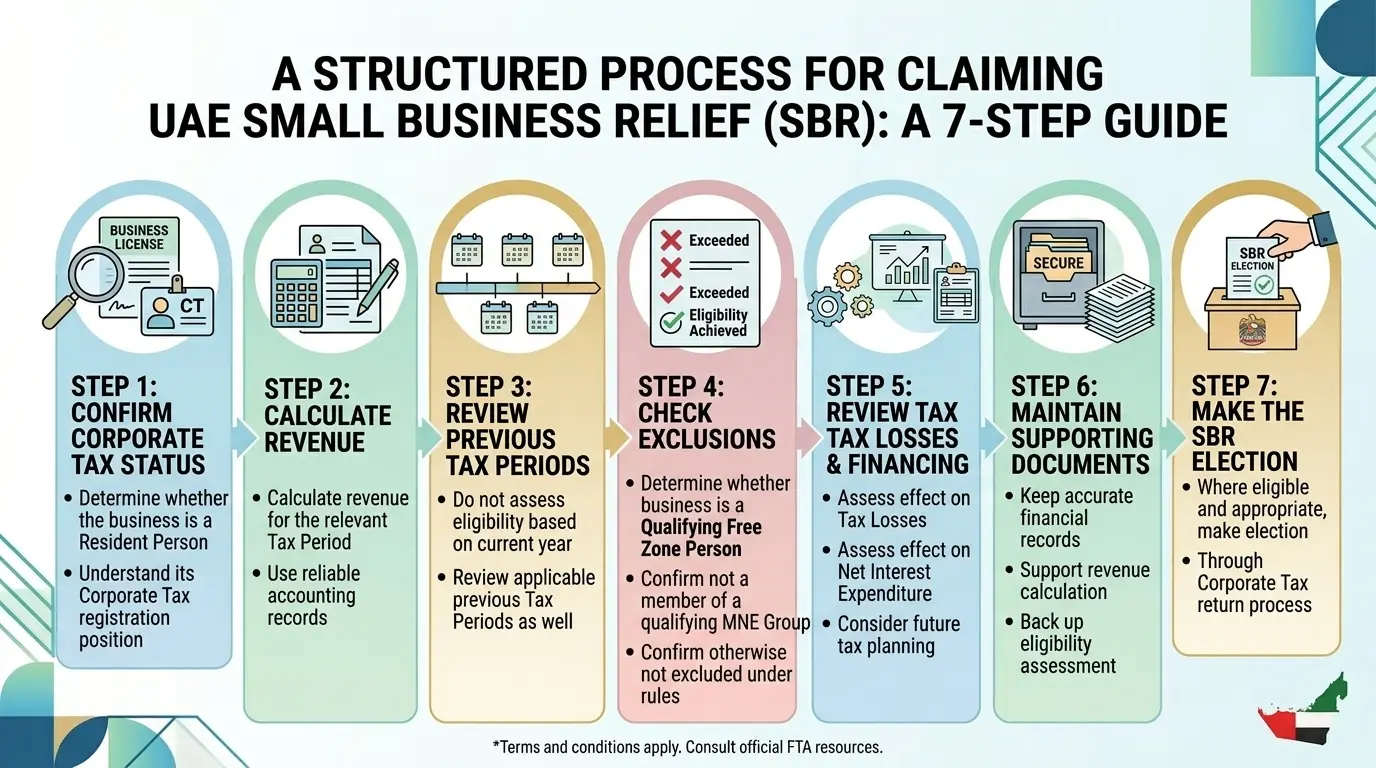
Businesses considering SBR should follow a structured process.
Step 1: Confirm Corporate Tax Status
Determine whether the business is a Resident Person and understand its Corporate Tax registration position.
Step 2: Calculate Revenue
Calculate revenue for the relevant Tax Period using reliable accounting records.
Step 3: Review Previous Tax Periods
Do not assess eligibility based only on the current year's revenue.
Review applicable previous Tax Periods as well.
Step 4: Check Exclusions
Determine whether the business is:
A Qualifying Free Zone Person; or
A member of a qualifying MNE Group; or
Otherwise excluded under the applicable rules.
Step 5: Review Tax Losses and Financing
Assess whether an SBR election could affect:
Tax Losses
Net Interest Expenditure
Future tax planning
Step 6: Maintain Supporting Documents
Keep accurate financial records supporting the revenue calculation and eligibility assessment.
Step 7: Make the SBR Election
Where eligible and appropriate, make the Small Business Relief election through the Corporate Tax return process.
What Records Should Small Businesses Maintain?
Even businesses benefiting from Small Business Relief should maintain reliable accounting records.
Important records can include:
Sales invoices
Purchase invoices
Bank statements
Sales ledgers
Expense records
Contracts
Customer records
Supplier records
Payroll records
Related-party transaction records
Financial statements
Revenue calculations
Good bookkeeping is particularly important because the business may need to demonstrate that it satisfied the SBR requirements.
UAE Corporate Tax Relief 2029: Mainland vs Free Zone Businesses
The SBR rules are especially important when comparing mainland and Free Zone structures.
| Business Type | SBR Consideration |
|---|---|
| UAE Mainland SME | May qualify if applicable conditions are satisfied |
| UAE Startup | May qualify if applicable conditions are satisfied |
| Standard Free Zone Person | May need to assess SBR eligibility and other CT rules |
| Qualifying Free Zone Person | Cannot elect for SBR |
| MNE Group Member | May be excluded depending on applicable conditions |
Free Zone businesses should therefore avoid assuming that “Free Zone = 0% Corporate Tax” or that “revenue below AED 3 million = SBR.”
The correct Corporate Tax treatment depends on the company's status and circumstances.
Should Your Business Choose Small Business Relief?
The answer depends on your financial position.
For a simple small business with:
Revenue below AED 3 million
No significant Tax Losses
Limited financing
No complex group structure
No major restructuring plans
SBR may provide a straightforward way to reduce the Corporate Tax burden.
However, a rapidly growing company may need a more detailed analysis.
Consider professional advice if your business has:
Significant Tax Losses
Large loans
Related-party transactions
Overseas shareholders
Multiple UAE entities
Free Zone operations
Planned restructuring
Rapid revenue growth
Expected revenue close to AED 3 million
MNE group relationships
What UAE Businesses Should Do Now
The reported extension to 2029 gives eligible small businesses additional planning time.
However, businesses should not wait until the end of the Tax Period to review their position.
Recommended checklist
1. Review your Corporate Tax registration
Make sure your registration obligations are understood.
2. Monitor revenue monthly
Track revenue against the AED 3 million SBR threshold.
3. Maintain proper bookkeeping
Reliable accounts make tax compliance and eligibility assessments easier.
4. Review previous Tax Periods
SBR eligibility is not necessarily determined by the current year alone.
5. Check your Free Zone status
Determine whether your company is a QFZP.
6. Review your group structure
Check whether MNE-related exclusions could apply.
7. Consider Tax Losses
Do not make the SBR election without understanding its potential effect on future tax planning.
8. Plan before filing
Evaluate whether SBR is appropriate before submitting the Corporate Tax return.
How Axiomate Pro Can Help With UAE Corporate Tax Relief
At Axiomate Pro, we help UAE businesses understand and manage their Corporate Tax obligations while maintaining accurate financial records.
Our Corporate Tax support can include:
Small Business Relief Eligibility Assessment
We review your revenue, business structure, Free Zone status, and other relevant factors to assess whether SBR may apply.
Corporate Tax Registration
We assist businesses with UAE Corporate Tax registration and related compliance requirements.
Corporate Tax Return Filing
Our team helps prepare and submit Corporate Tax returns accurately and within the applicable deadlines.
IFRS-Compliant Accounting
Accurate bookkeeping provides the financial information needed to monitor revenue, profitability, and Corporate Tax obligations.
Tax Planning
We assess SBR alongside Tax Losses, financing, group structures, and expected business growth.
Ongoing Compliance
Axiomate Pro can support businesses with accounting, VAT, Corporate Tax, audit, and broader financial compliance.

Book a Free Accounting Consultation
Axiomate Pro helps UAE businesses answer that question through Corporate Tax advisory, accounting, VAT compliance, audit, and financial advisory services.
Need help assessing your UAE Corporate Tax position? Contact Axiomate Pro for a consultation with our tax and accounting specialists.
Book Your Free ConsultationFrequently Asked Questions
What is UAE Corporate Tax Relief 2029?
The term generally refers to the reported extension of the UAE Small Business Relief regime through 2029. Eligible businesses may be able to continue electing for SBR subject to the applicable conditions.
What is the Small Business Relief threshold in the UAE?
The key threshold is AED 3 million in revenue, subject to the applicable rules and previous Tax Period requirements.
Has UAE Small Business Relief been extended to 2029?
The extension has been publicly reported as extending Small Business Relief to Tax Periods ending on or before 31 December 2029. Businesses should verify the latest official MoF and FTA guidance when filing.
Is Small Business Relief the same as a 0% Corporate Tax rate?
No. SBR is a relief mechanism under which an eligible taxpayer can elect to be treated as having no Taxable Income for the relevant Tax Period, subject to the applicable rules.
Can a company with revenue below AED 3 million claim SBR?
Potentially, but revenue is only one condition. The company must also satisfy the applicable eligibility requirements and must not fall within an excluded category.
Can a Qualifying Free Zone Person claim Small Business Relief?
No. QFZPs are excluded from the Small Business Relief regime.
Does SBR mean I do not need Corporate Tax registration?
No. Small Business Relief should not be treated as a general exemption from Corporate Tax registration or other applicable compliance obligations.
Does SBR affect Tax Losses?
Yes. Electing for SBR can affect the treatment and future use of certain Tax Losses, so businesses should consider this before making the election.
What happens if revenue exceeds AED 3 million?
Exceeding the applicable threshold can affect eligibility for Small Business Relief. Businesses approaching AED 3 million should monitor revenue carefully and review their Corporate Tax position.
Can startups claim Small Business Relief?
Eligible UAE startups may be able to claim SBR if they satisfy the applicable conditions. New businesses should assess their Corporate Tax registration, revenue, structure, and future growth plans before making an election.
Final Thoughts on UAE Corporate Tax Relief 2029
The reported extension of UAE Small Business Relief through 2029 is important news for startups, entrepreneurs, and SMEs across the UAE.
For eligible businesses, the additional period can provide greater flexibility while they build revenue, strengthen operations, and establish sustainable financial systems.
However, the AED 3 million threshold should not be viewed in isolation.
Businesses should also consider:
Corporate Tax registration
Previous Tax Periods
Free Zone status
Group structure
Tax Losses
Net Interest Expenditure
Related-party transactions
Accounting records
Future growth
The best approach is therefore not simply to ask:
“Can my business claim Small Business Relief?”
Instead, ask:
“Is Small Business Relief the right Corporate Tax strategy for my business?”
DisclaimerThis article is provided for general educational and informational purposes only and does not constitute tax, legal, accounting, or financial advice. UAE Corporate Tax legislation, Ministerial Decisions, Federal Tax Authority guidance, and Small Business Relief requirements may change, and the information presented in this article may not reflect subsequent amendments or updates.
Readers should verify the latest requirements and official interpretations directly with the UAE Ministry of Finance and Federal Tax Authority before relying on any information contained in this article or making a Corporate Tax election, filing, or business decision. Where appropriate, businesses should seek professional tax or accounting advice based on their specific circumstances.
Official sources: UAE Ministry of Finance, Federal Tax Authority, UAE Corporate Tax legislation, and official Small Business Relief guidance.